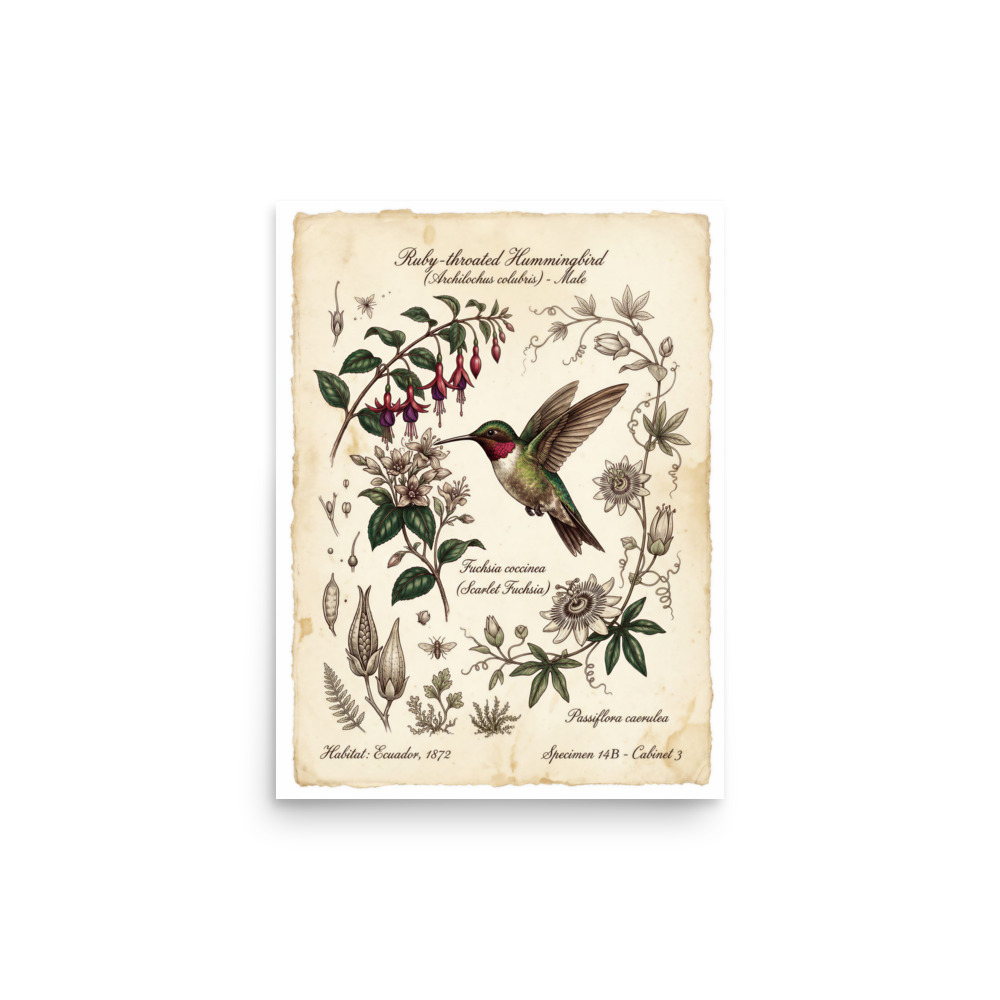
Hummingbird Study Art Print, Victorian botanical illustration, vintage gallery wall decor, naturalist gift, scholarly home office
A detailed hummingbird study brings Victorian naturalist art to an art print, pairing fine ink botanical sketches with handwritten specimen labels in a sepia, deep green, and aged cream palette. Printed on Enhanced Matte Paper (189 g/m²), its scholarly curiosity-cabinet character suits a gallery wall, reading nook, or thoughtful gift for a bird and botanical art lover.
The hummingbird belongs to the Victorian tradition of close natural observation, when birds, plants, insects, and other specimens were recorded in books, study rooms, and private collections. Naturalist imagery brought the field indoors: a small bird could be examined beside a leaf, flower, or seed, with written notes preserving details that a single glance might miss. Hummingbirds were especially suited to this kind of study because their narrow bills, compact bodies, and rapidly beating wings offered distinctive forms to document. This print draws on that nineteenth-century language of classification and curiosity, evoking the atmosphere of a cabinet of specimens or a naturalist’s desk rather than a modern wildlife photograph. Its subject carries the feeling of a page removed from a well-used botanical volume, where observation, handwriting, and illustration sit together as part of the same record.
Here, the bird is presented as a precise study within a restrained composition. Fine ink lines define the hummingbird’s curved bill, rounded head, tapered wings, and small body, while nearby botanical forms create a framework of stems, leaves, and delicate organic contours. Handwritten specimen-style notes add horizontal lines and irregular letterforms across the page, giving the image the visual rhythm of a working document. The colours remain quietly archival: sepia ink, deep green foliage, and an aged cream ground form a warm palette that sits comfortably beside wood, brass, leather, and other natural materials. Rather than relying on a bright, decorative treatment, the artwork uses contrast between the dark bird, fine plant marks, and open cream space to make each detail easy to follow. In a black, walnut, or antique-gold frame, it can read as a vintage plate; in a simple oak frame, the botanical lines and muted tones feel lighter and more contemporary. Hung alone, it has the focus of a study page. Grouped with maps, pressed-flower imagery, insect plates, or other specimen prints, it becomes part of a considered gallery wall.
This is for the person who notices the small evidence of looking closely: the shape of a leaf, the structure of a wing, the difference between a printed caption and a handwritten note. A bird lover may be drawn first to the hummingbird’s compact silhouette and fine bill, while a gardener or plant enthusiast may find equal interest in the surrounding stems and leaves. It also suits someone who prefers visual references with a scholarly character—an academic, reader, collector, teacher, or naturalist at heart—without requiring the room to feel formal. Place it above a writing desk, beside a bookcase, in a reading nook, or among framed botanical and architectural studies in a hallway. The subdued sepia, green, and cream colours work with painted walls, exposed wood, linen upholstery, and shelves of books. As a gift, it speaks to an interest in birds, gardens, field notes, and the quiet pleasure of studying the natural world.
| Material | Enhanced Matte Paper (189 g/m²) |
| Digital printing | |
| Care | Frame or mount out of direct sunlight; wipe gently with a dry, soft cloth. |
| Shipping | Made to order — ships in 2–5 business days |